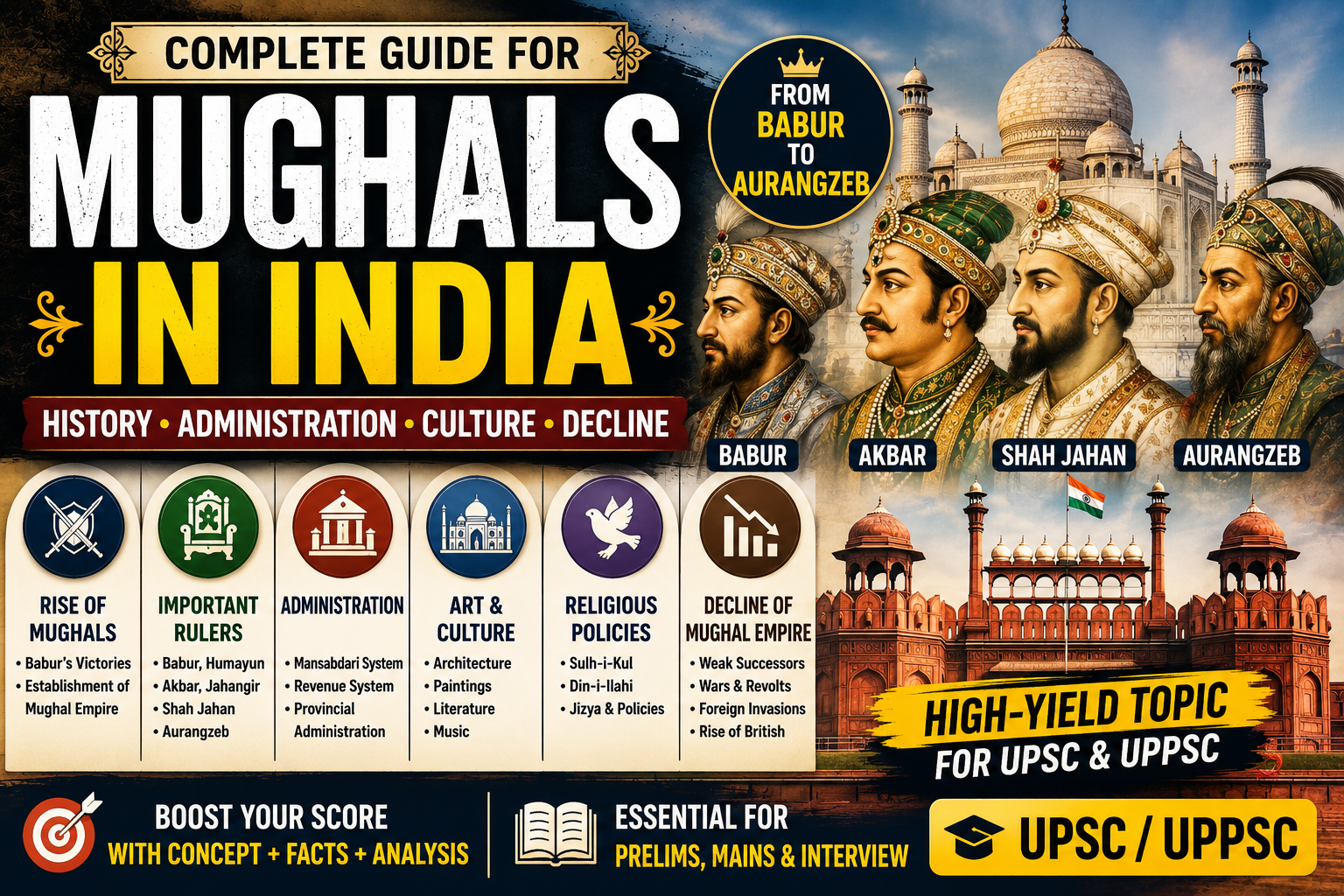
Mughal Empire in India: History, Administration, Culture, and Decline
The Mughal Empire holds a very important place in Indian history and is one of the most significant topics for aspirants preparing for the Union Public Service Commission and various State PCS examinations such as UPPSC.
The Mughals not only established one of the largest empires in Indian history but also influenced administration, architecture, economy, literature, culture, and society for centuries. Questions related to Mughal rulers, administration, art and culture, Mansabdari system, religious policies, and decline of the empire are frequently asked in both Prelims and Mains examinations.
This blog provides a complete overview of the Mughal Empire from the UPSC and UPPSC perspective.
Introduction to the Mughal Empire
The Mughal Empire was founded by Babur in 1526 after defeating Ibrahim Lodi in the First Battle of Panipat.
The term “Mughal” is derived from the word “Mongol.” The Mughals were originally of Central Asian origin and traced their lineage to:
- Timur from the father’s side
- Genghis Khan from the mother’s side
The Mughal Empire ruled large parts of India from the early 16th century to the mid-19th century.
Important Mughal Rulers
1. Babur (1526–1530)
Babur founded the Mughal Empire in India.
Important Facts
- Defeated Ibrahim Lodi in the First Battle of Panipat (1526)
- Defeated Rana Sanga in the Battle of Khanwa (1527)
- Introduced gunpowder and artillery warfare effectively in India
- Wrote his autobiography “Baburnama”
UPSC/UPPSC Focus
- Battles fought by Babur
- Use of artillery
- Baburnama
2. Humayun (1530–1540 and 1555–1556)
Humayun was Babur’s son.
Important Facts
- Defeated by Sher Shah Suri
- Lost the Mughal throne temporarily
- Re-established Mughal rule in 1555
UPSC/UPPSC Focus
- Sher Shah’s administration
- Persian influence during exile
3. Akbar (1556–1605)
Akbar is considered the greatest Mughal ruler.
Major Achievements
Administrative Reforms
- Introduced Mansabdari System
- Centralized administration
- Efficient revenue system under Todar Mal
Religious Policy
- Followed Sulh-i-Kul (Universal Peace)
- Abolished Jizya tax
- Started Din-i-Ilahi
Military Expansion
Expanded Mughal rule over:
- Rajasthan
- Gujarat
- Bengal
- Deccan regions
Navratnas of Akbar
Important members included:
- Birbal
- Tansen
- Abul Fazl
- Raja Todar Mal
UPSC/UPPSC Focus
- Mansabdari System
- Din-i-Ilahi
- Revenue administration
- Religious tolerance
Mansabdari System
The Mansabdari System was introduced by Akbar to organize:
- Military administration
- Civil administration
Each officer was given a rank called “Mansab.”
The rank determined:
- Salary
- Position
- Number of soldiers maintained
This is one of the most important topics for UPSC and UPPSC exams.
4. Jahangir (1605–1627)
Jahangir was known for justice and art patronage.
Important Facts
- Introduced the “Chain of Justice”
- Encouraged Mughal painting
- British East India Company received permission to trade during his reign
UPSC/UPPSC Focus
- Mughal paintings
- Relation with British traders
5. Shah Jahan (1628–1658)
Shah Jahan is famous for architecture.
Major Contributions
- Construction of the Taj Mahal
- Red Fort
- Jama Masjid
The Mughal period under Shah Jahan is often called the “Golden Age of Mughal Architecture.”
UPSC/UPPSC Focus
- Mughal architecture
- Features of Taj Mahal
- Persian architectural influence
6. Aurangzeb (1658–1707)
Aurangzeb was the last major Mughal ruler.
Important Facts
- Expanded the empire to its greatest territorial extent
- Reimposed Jizya tax
- Followed orthodox religious policies
- Faced revolts from:
- Marathas
- Sikhs
- Jats
- Rajputs
UPSC/UPPSC Focus
- Religious policy
- Deccan campaigns
- Causes of Mughal decline
Mughal Administration
The Mughal administration was highly centralized.
Important Administrative Divisions
- Suba (Province)
- Sarkar (District)
- Pargana
- Village
Important Officers
- Wazir — Prime Minister
- Diwan — Revenue officer
- Mir Bakshi — Military officer
- Qazi — Judicial officer
Revenue System
Akbar’s finance minister Raja Todar Mal introduced the “Zabt System.”
Features
- Land measurement
- Classification of land
- Fixed revenue rates
This system increased state revenue and administrative efficiency.
Mughal Art and Culture
The Mughal period witnessed major developments in:
- Architecture
- Painting
- Literature
- Music
Architecture
Major Mughal monuments:
- Taj Mahal
- Humayun’s Tomb
- Fatehpur Sikri
- Red Fort
Paintings
Mughal paintings combined:
- Persian style
- Indian themes
Literature
Persian became the court language.
Important books:
- Akbarnama
- Ain-i-Akbari
- Tuzuk-i-Jahangiri
Religious Policies of the Mughals
Akbar
- Religious tolerance
- Sulh-i-Kul
- Din-i-Ilahi
Aurangzeb
- Orthodox Sunni policies
- Reimposition of Jizya
Religious policies are frequently compared in UPSC Mains answers.
Decline of the Mughal Empire
After Aurangzeb’s death in 1707, the Mughal Empire started declining.
Major Causes
Weak Successors
Later rulers lacked administrative and military capabilities.
Continuous Wars
Long Deccan campaigns weakened the treasury.
Regional Revolts
- Marathas
- Sikhs
- Jats
- Rajputs challenged Mughal authority.
Foreign Invasions
- Nadir Shah invaded in 1739
- Ahmad Shah Abdali attacked repeatedly
Rise of British Power
The East India Company gradually expanded political control.
Importance of the Mughal Period for UPSC and UPPSC
Questions are commonly asked from:
- Battles
- Administration
- Revenue system
- Architecture
- Religious policies
- Mughal paintings
- Decline of the empire
For Mains examination, aspirants should focus on:
- Analytical understanding
- Comparison between rulers
- Impact on Indian society and culture
Preparation Strategy for Aspirants
For Prelims
Focus on:
- Dates
- Battles
- Books and authors
- Architecture
- Administrative terms
For Mains
Prepare:
- Comparative analysis
- Administrative reforms
- Religious policies
- Cultural contributions
- Causes of decline
Conclusion
The Mughal Empire was one of the most influential periods in Indian history. The Mughals shaped India’s political structure, economy, administration, architecture, and culture in significant ways.
For UPSC and UPPSC aspirants, the Mughal period is extremely important because it combines:
- Political history
- Art and culture
- Administration
- Economy
- Society
A conceptual understanding of Mughal rulers, systems, and historical developments can help aspirants score well in both objective and descriptive examinations.
Studying the Mughal period not only helps in exams but also provides a deeper understanding of India’s historical and cultural heritage.