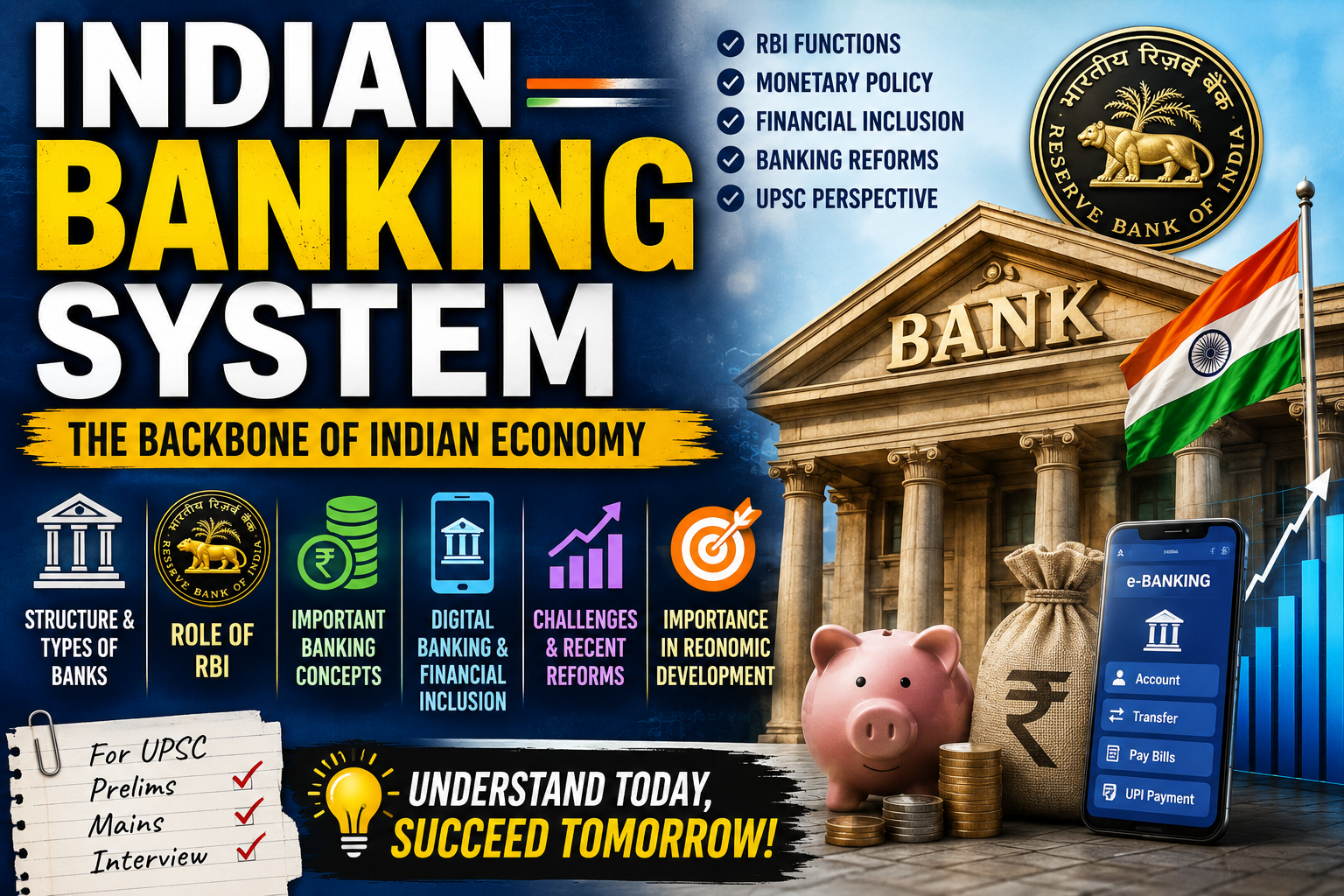
Indian Banking System: Structure, Functions, and Importance in the Indian Economy
The Indian Banking System is one of the most important pillars of the Indian economy. It plays a major role in economic development by mobilizing savings, providing credit, supporting businesses, encouraging investment, and implementing government financial policies.
For aspirants preparing for the Union Public Service Commission Civil Services Examination, the banking system is an important topic in Economics, especially for Prelims, Mains, and interviews.
Understanding the Indian Banking System helps aspirants connect concepts related to inflation, monetary policy, economic growth, financial inclusion, and government reforms.
What is the Banking System?
A banking system refers to the network of institutions that:
- Accept deposits from the public
- Provide loans and credit
- Facilitate payments and transactions
- Support economic activities
- Maintain financial stability
Banks act as intermediaries between savers and borrowers.
Structure of the Indian Banking System
The Indian Banking System is broadly divided into two major categories:
1. Scheduled Banks
These banks are included in the Second Schedule of the Reserve Bank of India Act, 1934.
Scheduled banks include:
- Commercial Banks
- Cooperative Banks
2. Non-Scheduled Banks
Banks that are not included in the Second Schedule of the RBI Act are called non-scheduled banks.
Their role in the economy is comparatively limited.
Reserve Bank of India (RBI)
The Reserve Bank of India is the central bank of India and the apex institution of the banking system.
It was established in 1935 and nationalized in 1949.
Major Functions of RBI
Monetary Authority
RBI controls money supply and credit in the economy.
Issuer of Currency
It has the sole authority to issue currency notes in India except one rupee notes and coins.
Banker to Government
RBI manages banking transactions of the central and state governments.
Bankers’ Bank
Commercial banks keep deposits with RBI.
Controller of Credit
RBI controls inflation and economic stability through monetary policy tools.
Foreign Exchange Management
RBI manages foreign exchange reserves and exchange rate stability.
Commercial Banks in India
Commercial banks are profit-oriented institutions that accept deposits and provide loans.
They are classified into:
Public Sector Banks
Banks where the government holds the majority stake.
Examples:
- State Bank of India
- Punjab National Bank
These banks play a major role in implementing government schemes.
Private Sector Banks
Owned mainly by private shareholders.
Examples:
- HDFC Bank
- ICICI Bank
These banks are known for technological innovation and customer services.
Foreign Banks
Banks headquartered outside India but operating in India.
Examples:
- Citibank
- HSBC
Cooperative Banks
Cooperative banks operate on cooperative principles and mainly provide credit to:
- Farmers
- Small businesses
- Rural populations
They are important for rural credit distribution.
Types:
- State Cooperative Banks
- District Cooperative Banks
- Primary Agricultural Credit Societies (PACS)
Regional Rural Banks (RRBs)
Regional Rural Banks were established to provide banking and credit facilities in rural areas.
Objectives:
- Financial inclusion
- Rural development
- Agricultural credit support
RRBs combine the local familiarity of cooperative banks with the professionalism of commercial banks.
Important Banking Concepts for UPSC
CRR (Cash Reserve Ratio)
It is the percentage of deposits commercial banks must keep with RBI in cash form.
Higher CRR:
- Reduces money supply
Lower CRR:
- Increases liquidity
SLR (Statutory Liquidity Ratio)
It is the percentage of deposits banks must maintain in liquid assets like gold or government securities.
Repo Rate
The rate at which RBI lends money to commercial banks.
Increase in repo rate:
- Loans become expensive
- Inflation may reduce
Decrease in repo rate:
- Credit becomes cheaper
- Economic activity may increase
Reverse Repo Rate
The rate at which RBI borrows money from commercial banks.
Inflation
Inflation means a sustained rise in the general price level.
RBI controls inflation mainly through monetary policy tools.
Financial Inclusion
Financial inclusion means ensuring banking services for all sections of society.
Important initiatives:
- Pradhan Mantri Jan Dhan Yojana (PMJDY)
- Digital payments
- UPI system
- Direct Benefit Transfer (DBT)
Financial inclusion helps reduce poverty and supports economic growth.
Digital Banking in India
India has witnessed rapid growth in digital banking.
Key developments:
- Internet banking
- Mobile banking
- UPI payments
- Digital wallets
- Aadhaar-enabled payment systems
Digital banking has improved convenience, transparency, and financial accessibility.
Challenges in the Indian Banking System
Non-Performing Assets (NPAs)
Loans that are not repaid on time become NPAs.
High NPAs reduce bank profitability and financial stability.
Cybersecurity Risks
Increasing digital transactions have also increased cyber fraud risks.
Rural Banking Challenges
Many rural areas still face:
- Low banking awareness
- Poor infrastructure
- Limited financial literacy
Bank Frauds
Financial scams and frauds affect public trust in the banking system.
Recent Banking Reforms
The government and RBI have introduced several reforms:
- Bank recapitalization
- Bank mergers
- Insolvency and Bankruptcy Code (IBC)
- Digital banking promotion
- Strengthening NPA recovery mechanisms
These reforms aim to improve efficiency and stability in the banking sector.
Importance of Banking System in Economic Development
The banking system contributes to:
- Capital formation
- Industrial growth
- Agricultural development
- Employment generation
- Trade and commerce
- Infrastructure financing
A strong banking system is essential for sustainable economic growth.
Conclusion
The Indian Banking System is the backbone of the Indian economy. From controlling inflation to supporting industries and ensuring financial inclusion, banks play a crucial role in national development.
For UPSC aspirants, understanding the banking system is important not only for Economics but also for current affairs, governance, and public policy.
A conceptual understanding of banking terms, RBI functions, financial reforms, and current developments can significantly improve performance in both Prelims and Mains examinations.
In today’s rapidly changing economic environment, knowledge of the banking sector is not just useful for examinations — it is essential for understanding how the Indian economy functions.