Blockchain-Based Digital Governance
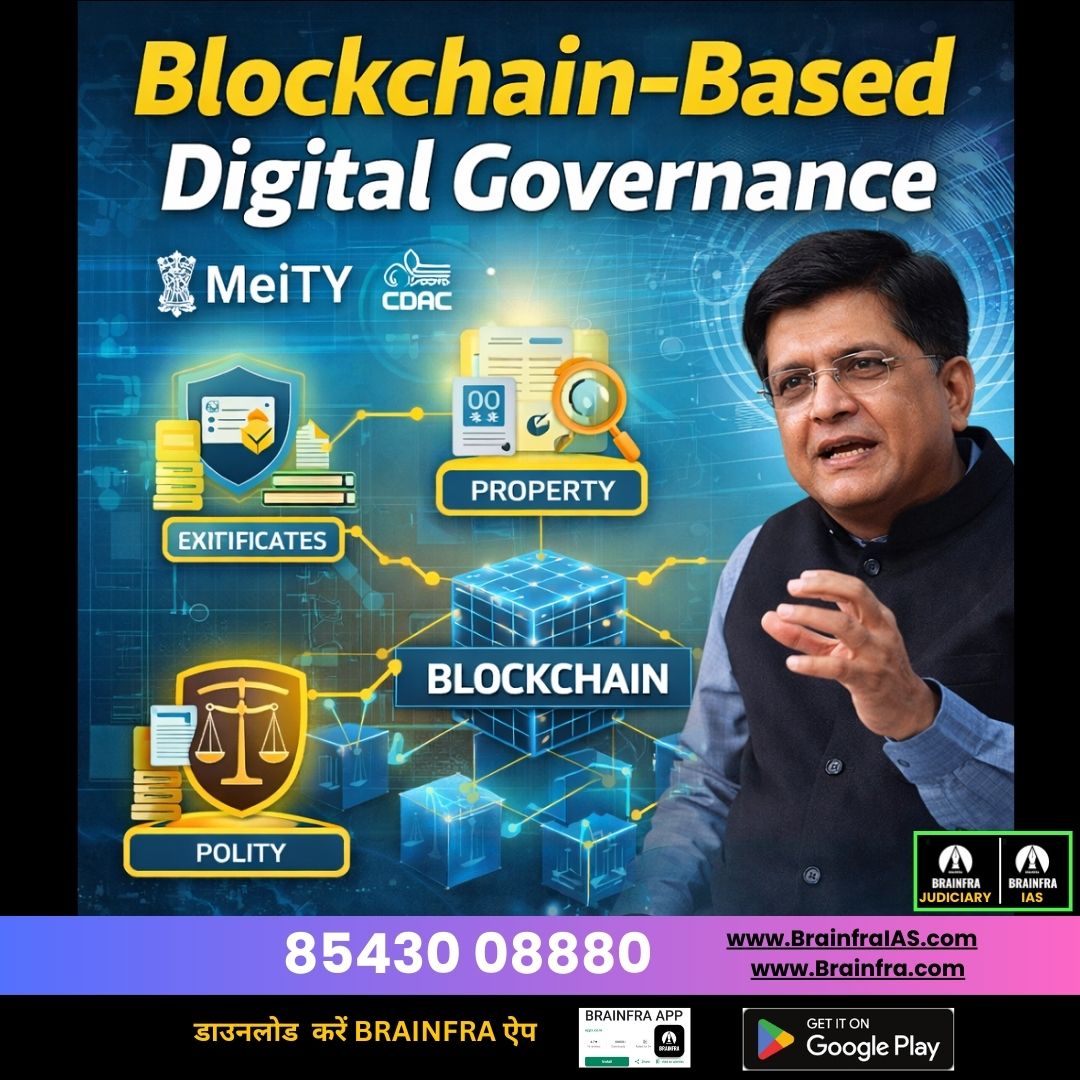
Blockchain is a decentralized and distributed ledger technology that ensures tamper-proof, transparent, and auditable record-keeping. It operates on the principles of immutability, consensus, and cryptographic security, making data manipulation virtually impossible. Recognizing its potential, the Ministry of Electronics and Information Technology (MeitY) along with C-DAC launched the Blockchain India Challenge to encourage startups to pilot governance solutions.
In governance, blockchain enhances trust and efficiency. For instance, NIC’s “Certificate Chain” ensures secure storage and retrieval of academic and other certificates, reducing fraud and verification delays. In logistics, Karnataka’s ‘Aushada’ system tracks medicines from manufacturers to hospitals, allowing patients to verify quality and expiry details, thereby curbing spurious drugs.
In the judiciary, the Inter-Operable Criminal Justice System (ICJS) integrates case records and evidence across departments. Similarly, blockchain-based property management systems record transactions transparently, reducing litigation and ownership disputes.
Additional proof-of-concepts include remote voting, GST monitoring, blood bank management, and the Public Distribution System (PDS).
Further strengthening the ecosystem, the National Blockchain Framework (NBF) provides unified architecture through components such as Vishvasya Stack, NBFLite, and Praamaanik. A Centre of Excellence in Blockchain Technology offers Blockchain-as-a-Service infrastructure, while states like Andhra Pradesh, Telangana, and Maharashtra have piloted blockchain-based land record systems.
Thus, blockchain can significantly improve transparency, accountability, and citizen trust in digital governance.
#UPSCMains #Blockchain #DigitalGovernance #MeitY #ICJS #LandRecords #GS3 #UPSCPreparation #Egovernance #EmergingTech
ब्लॉकचेन आधारित डिजिटल गवर्नेंस
ब्लॉकचेन एक विकेन्द्रीकृत एवं वितरित लेज़र तकनीक है, जो डेटा को छेड़छाड़ से सुरक्षित, पारदर्शी एवं ऑडिट योग्य बनाती है। यह अपरिवर्तनीयता (immutability), सहमति तंत्र (consensus) एवं क्रिप्टोग्राफिक सुरक्षा के सिद्धांतों पर आधारित है। इसी दिशा में MeitY एवं C-DAC ने ‘Blockchain India Challenge’ शुरू किया है, ताकि स्टार्टअप्स डिजिटल गवर्नेंस समाधान विकसित कर सकें।
शासन में ब्लॉकचेन पारदर्शिता एवं विश्वसनीयता बढ़ाता है। उदाहरणतः NIC का ‘Certificate Chain’ शैक्षणिक प्रमाणपत्रों के सुरक्षित सत्यापन में सहायक है। कर्नाटक की ‘Aushada’ प्रणाली दवा की आपूर्ति श्रृंखला को ट्रैक करती है, जिससे नकली दवाओं पर अंकुश लगता है।
न्यायिक क्षेत्र में ICJS आपराधिक न्याय प्रणाली को एकीकृत डिजिटल मंच प्रदान करता है। इसी प्रकार ब्लॉकचेन आधारित संपत्ति प्रबंधन प्रणाली स्वामित्व एवं लेन-देन का सुरक्षित रिकॉर्ड रखकर विवाद कम करती है।
रिमोट वोटिंग, GST मॉनिटरिंग, रक्त बैंक और सार्वजनिक वितरण प्रणाली (PDS) में भी प्रायोगिक पहल चल रही हैं।
राष्ट्रीय ब्लॉकचेन ढांचा (NBF) के माध्यम से Vishvasya Stack, NBFLite एवं Praamaanik जैसे घटकों के साथ एकीकृत संरचना प्रदान की गई है। आंध्र प्रदेश, तेलंगाना और महाराष्ट्र ने भूमि अभिलेख प्रबंधन में ब्लॉकचेन का पायलट प्रयोग किया है।
अतः ब्लॉकचेन तकनीक डिजिटल शासन में पारदर्शिता, उत्तरदायित्व एवं जनविश्वास को सुदृढ़ कर सकती है।
#UPSCMains #ब्लॉकचेन #डिजिटल_गवर्नेंस #MeitY #GS3 #ईगवर्नेंस #UPSCPreparation #भूमि_अभिलेख #उभरती_तकनीक