India’s Trade Diversification Push
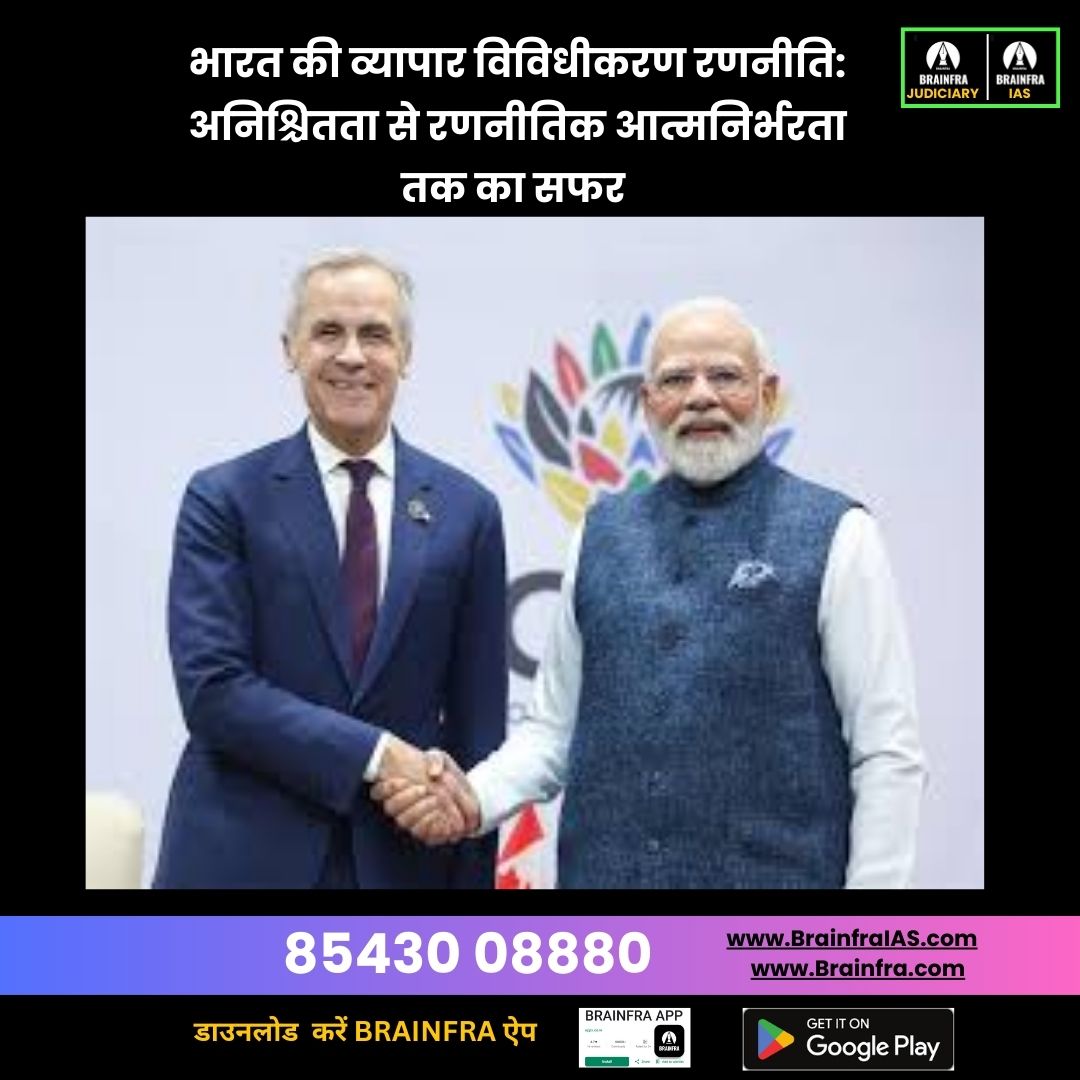
भारत की व्यापार विविधीकरण रणनीति: अनिश्चितता से रणनीतिक आत्मनिर्भरता तक का सफर 📦🇮🇳
भारत आज वैश्विक व्यापार के नए युग में प्रवेश कर चुका है। अमेरिका से टैरिफ में राहत (25% से घटकर 18%) और रूसी तेल पर अतिरिक्त 25% दंड हटने से अल्पकालिक राहत जरूर मिली है, लेकिन भारत ने यह स्पष्ट कर दिया है कि उसकी रणनीति अब किसी एक बाजार पर निर्भर रहने की नहीं, बल्कि बहु-आधार (Multiple Anchors) और रणनीतिक स्वायत्तता की है।
🌍 भारत को व्यापार विविधीकरण की ओर धकेलने वाले प्रमुख कारक
🔹 1. “ट्रेड का हथियारीकरण” और अमेरिकी अस्थिरता
अब अमेरिका कोई स्थिर एंकर नहीं रहा, बल्कि एक भू-राजनीतिक लीवर बन गया है।
- क्वाड जैसी राजनीतिक साझेदारी भी आर्थिक सुरक्षा की गारंटी नहीं बनी।
- दिसंबर 2025 में अमेरिका को भारत का निर्यात 1.83% घटकर $6.88 अरब रहा।
👉 भारत अब अपने निर्यात दांव को “हेज” कर रहा है।
🔹 2. “क्रिटिकल मिनरल” सुरक्षा की अनिवार्यता
EV, सेमीकंडक्टर और PLI आधारित उद्योगों के लिए लिथियम, कोबाल्ट और रेयर अर्थ अनिवार्य हैं।
- अफ्रीका और लैटिन अमेरिका अब सिर्फ बाजार नहीं, बल्कि “संसाधन साझेदार” बन रहे हैं।
- बजट 2026–27 में ओडिशा, केरल, आंध्र प्रदेश, तमिलनाडु में रेयर अर्थ कॉरिडोर की घोषणा।
- KABIL (NALCO, HCL, MECL) के माध्यम से विदेशों में खनिज अधिग्रहण।
🔹 3. “ग्लोबल साउथ” की ग्रोथ आर्बिट्राज
पश्चिमी बाजार जनसांख्यिकीय रूप से ठहर चुके हैं, जबकि ग्लोबल साउथ युवा आबादी के साथ उपभोग विस्फोट के दौर में है।
- सस्ती दवाइयाँ, टू-व्हीलर, टेक उत्पादों से भारत भविष्य की मांग सुरक्षित कर रहा है।
- UNCTAD 2025 के अनुसार भारत ग्लोबल साउथ में ट्रेड पार्टनर विविधीकरण में तीसरे स्थान पर है।
🔹 4. ग्रीन एनर्जी निर्यात
भारत सस्ती अक्षय ऊर्जा क्षमता को निर्यात में बदलना चाहता है।
- जापान, दक्षिण कोरिया, जर्मनी जैसे ऊर्जा-आयातक देशों पर फोकस।
- FY22 से FY24 के बीच सोलर PV निर्यात 23 गुना बढ़ा।
🌎 भारत कैसे कर रहा है बाजार विविधीकरण?
✅ 1. यूरोप और UK में रणनीतिक एंकरिंग
- जनवरी 2026 में EU-India FTA (99% निर्यात कवर)
- अमेरिका की अस्थिरता के बीच वैकल्पिक प्रीमियम बाजार सुनिश्चित
✅ 2. PLI के जरिए वैल्यू चेन में ऊपर उठना
- कच्चे माल से हाई-वैल्यू इलेक्ट्रॉनिक्स और इंजीनियरिंग उत्पादों की ओर बदलाव
- 2025 में इलेक्ट्रॉनिक्स निर्यात ₹4 लाख करोड़
✅ 3. अफ्रीका, लैटिन अमेरिका, GCC की ओर रुख
- अफ्रीका को 20% फार्मा निर्यात
- 2023-24 में लैटिन अमेरिका व्यापार $35.73 अरब
- GCC के साथ FTA वार्ता
✅ 4. रूपया व्यापार और डी-डॉलराइजेशन
- UAE से कच्चे तेल का भुगतान रुपये में
- UPI-PayNow लिंक से सिंगापुर में रीयल-टाइम सेटलमेंट
✅ 5. लॉजिस्टिक्स और एनर्जी कॉरिडोर
- IMEC कॉरिडोर
- लॉजिस्टिक्स लागत 13-14% से घटकर 7.97% GDP
✅ 6. निवेश-प्रथम मॉडल (EFTA TEPA)
- 15 वर्षों में $100 अरब निवेश प्रतिबद्धता
⚠️ प्रमुख चुनौतियाँ
❗ EU का CBAM और ग्रीन प्रोटेक्शनिज्म
❗ मोबाइल निर्माण में केवल 23% घरेलू वैल्यू एडिशन
❗ चीन पर कंपोनेंट निर्भरता
❗ FTA उपयोग दर सिर्फ 25%
❗ RCEP से बाहर रहना
❗ निर्यात प्रतिबंधों से विश्वसनीयता जोखिम
🔥 आगे का रास्ता – रणनीतिक समाधान
🔹 BIS के लिए Mutual Recognition Agreements
🔹 “प्रोडक्ट-एज़-ए-सर्विस” मॉडल (AI, मेंटेनेंस, सॉफ्टवेयर एम्बेडिंग)
🔹 डिजिटल पब्लिक इंफ्रास्ट्रक्चर आधारित E-Commerce Export Hubs
🔹 PLI 2.0 में बैकवर्ड इंटीग्रेशन
🔹 घरेलू कार्बन ट्रेडिंग से CBAM का मुकाबला
🔹 मिनीलैटरल सप्लाई चेन साझेदारी (जैसे ऑस्ट्रेलिया-क्रिटिकल मिनरल)
🎯 निष्कर्ष
भारत का लक्ष्य अब किसी एक बाजार पर निर्भर रहना नहीं है, बल्कि रणनीतिक स्वायत्तता (Strategic Autonomy) हासिल करना है।
टैरिफ राहत और FTA केवल तात्कालिक लाभ हैं। असली जीत तब होगी जब:
✔ घरेलू वैल्यू एडिशन गहरा होगा
✔ सप्लाई चेन सुरक्षित होंगी
✔ निर्यात नेटवर्क विविध और टिकाऊ होगा
भारत की व्यापार नीति अब “रिएक्टिव” नहीं, बल्कि “प्रोएक्टिव और रणनीतिक” है।
अनिश्चित वैश्विक व्यवस्था में भारत अवसर तलाश रहा है — और उसे शक्ति में बदल रहा है।
🔖 #IndiasTrade #TradeDiversification #AtmanirbharBharat #GlobalSouth #StrategicAutonomy #PLI #GreenEnergy #CriticalMinerals #DeDollarization #MakeInIndia #IndiaEUFTA #IMEC #EconomicResilience
India has secured significant tariff relief from the US, with reciprocal tariffs reduced from 25% to 18% and the additional 25% penalty on Russian oil imports lifted. While this provides immediate relief to exporters and capital markets, the agreement came after India had already begun aggressively diversifying its export markets and pursuing trade deals with partners like the EU. India must continue strengthening alternative markets and building domestic resilience rather than becoming overly dependent on US trade concessions.
What are the Key Drivers Pushing India to Diversify its Trade Market?
- The "Weaponization of Trade" & US Volatility: The primary propellant is the realization that the US market is no longer a "stable anchor" but a geopolitical lever that can be switched off arbitrarily.
- The recent tariff shock demonstrated that political alignment (Quad) does not guarantee economic immunity, forcing India to "hedge" its export bets.
- For instance, India's merchandise exports to the US slipped 1.83% year-on-year to $6.88 billion in December 2025, weighed down by higher tariffs (though it has eased recently)
- The "Critical Mineral" Security Imperative: Diversification is now driven by the "input side”, the urgent need to secure lithium, cobalt, and rare earths to feed India's domestic PLI ecosystems (EVs, semiconductors) without relying on China.
- This has forced a foreign policy pivot toward mineral-rich nations in Africa and Latin America, transforming them from just "export destinations" into strategic "resource partners."
- Union Budget 2026–27 announces Dedicated Rare Earth Corridors in Odisha, Kerala, Andhra Pradesh, and Tamil Nadu for mining, processing, research, and manufacturing of Rare Earth Permanent Magnets (REPMs), bypassing Chinese processing.
- Also, to operationalise its strategy internationally, India established the KABIL (Khanij Bidesh India Ltd) joint venture, comprising NALCO, HCL and MECL, which is tasked with identifying, exploring and acquiring critical minerals.
- Capturing the "Growth Arbitrage" of the South: Strategically, India is moving where the future consumption is, realizing that Western markets are demographically stagnant while the Global South is entering a consumption boom.
- By establishing early dominance in these "youth-bulge" economies with affordable goods (pharma, 2-wheelers), India is effectively locking in the next 20 years of export demand.
- According to UNCTAD's Trade and Development Report 2025, India ranked among the leading economies in trade partner diversification, ranking 3rd in the Global South and recording a trade diversity score higher than all Global North economies.
- The "Green Energy" Export Imperative: India’s ambition to become a global Green energy hub forces a structural pivot away from the energy-rich US (which has its own cheap shale/IRA subsidies) toward energy-importing economies in East Asia and Europe.
- To monetize its renewable cost advantage, India is trying to aggressively cultivate markets like Japan, South Korea, and Germany.
- For instance, India's exports of solar photovoltaic (PV) products have surged by more than 23 times between Fiscal Year (FY) 2022 and FY2024.
How is India Diversifying its Trade Markets?
- Strategic Anchoring in Non-US Western Markets: India is aggressively hedging against US policy volatility by locking in long-term, duty-free access to other high-value consumption economies in Europe and the UK.
- This "multiple-anchor" strategy ensures that even if American tariffs fluctuate, Indian exporters have alternative premium markets for high-margin goods like textiles and leather.
- For instance, in January 2026, India and the European Union concluded negotiations for a comprehensive Free Trade Agreement (FTA), covering 99% of India's export trade.
- Moving Up the Value Chain via PLI: The diversification is not just geographic but structural, shifting the export basket from raw commodities to high-value finished electronics and precision engineering through the Production Linked Incentive (PLI) scheme.
- By embedding itself into Global Value Chains (GVCs) as a "Plus One" partner, India makes its exports stickier and less sensitive to simple price/tariff shocks.
- For instance, India's electronics exports hit ₹4 lakh crore in 2025, with further growth expected as four semiconductor plants begin production in 2026.
- The "Global South" Geographic Pivot: Recognizing saturation in the West, New Delhi is actively cultivating markets in Africa, Latin America, and Central Asia to absorb mid-tech manufacturing and generic pharmaceutical exports.
- This pivot taps into high-growth developing economies where Indian goods offer a "value-for-money" competitive advantage over expensive Western alternatives.
- For instance, Indian companies already account for about 20% of pharmaceutical exports to Africa, highlighting their critical role in the region’s healthcare system.
- India’s total trade with Latin American and Caribbean region, comprising of 43 countries, stood at USD 35.73 billion with exports worth USD 14.50 billion during 2023-24
- Also, recently, India and the Gulf Cooperation Council (GCC) have signed the Terms of Reference for a Free Trade Agreement in New Delhi.
- Currency Statecraft & De-Dollarization: To insulate its trade from geopolitical weaponization of the US Dollar and exchange rate volatility, India is operationalizing Rupee trade settlement mechanisms and digital payment linkages.
- This financial infrastructure allows trade to continue with sanction-hit or forex-starved nations without triggering US secondary sanctions.
- For instance, in 2023, India has made first-ever payment in rupees for crude oil purchased from the UAE, paving the way for the Internationalization of Indian Currency.
- Also, UPI-PayNow linkages with Singapore now process real-time cross-border trade settlements.
- Energy & Logistics Corridor Diplomacy: India is reducing its logistics vulnerability by developing physical trade corridors like the India-Middle East-Europe Corridor (IMEC) and securing energy from diverse sources (e.g, LNG from Qatar).
- This reduces the "transit risk" of relying solely on the Suez Canal or volatile shipping lanes, ensuring supply chain continuity for exporters.
- For instance, the India Oman CEPA anchors India’s logistics presence in the Gulf.
- Also, FY 2025-26 saw logistics costs coming down to 7.97% of GDP. This is a substantial decline from the previously cited, long-standing figures of 13-14%.
- The "Investment-First" Trade Model (EFTA): Moving beyond traditional tariff-for-tariff deals, India is pioneering "investment-linked" trade pacts like the TEPA with EFTA nations to secure technology transfers and long-term capital.
- This strategy reduces vulnerability to goods-export volatility by locking in massive Foreign Direct Investment (FDI) that builds domestic industrial capacity for global export markets.
- For instance, under the TEPA agreement, there is a commitment to invest $100 billion in India over a 15-year period.
What are the Key Issues Associated with India’s Market Diversification Move?
- The "Green Wall" of Non-Tariff Barriers: Diversifying into high-value Western markets like the EU is colliding with "Green Protectionism" tools like the Carbon Border Adjustment Mechanism (CBAM) and Deforestation Regulation (EUDR).
- These rigorous compliance standards disproportionately hit India's MSME-dominated export base, threatening to erode the cost arbitrage that Indian exporters rely upon to compete with Vietnam or Bangladesh.
- Although the recent India–EU FTA includes a forward-looking MFN clause on CBAM, ensuring that any future exemptions or flexibilities granted by the EU to other partners will also apply to India, its implementation remains uncertain.
- The "Import-Dependent Export" Trap: The pivot to electronics and engineering exports is structurally fragile because it relies heavily on assembly rather than deep component manufacturing.
- This "shallow" diversification creates a paradoxical vulnerability: boosting exports to the US or EU automatically spikes component imports from China, deepening the trade deficit with Beijing despite political decoupling efforts.
- For instance, Domestic value addition (DVA) in India's mobile phone manufacturing sector is just 23%. Conversely, over the last 15 years, China's share in India's industrial product imports has increased significantly, from 21% to 30%, creating a "sovereign risk" in critical supply chains.
- Logistics Inefficiency in Price-Sensitive Markets: While India seeks to capture "Global South" markets in Africa and Latin America, its high logistics costs make it uncompetitive against China’s mature Belt and Road infrastructure.
- Without seamless connectivity, Indian goods suffer margin erosion, making it difficult to displace entrenched Chinese suppliers in these price-sensitive geographies.
- Also, China's infrastructure and debt-driven influence contrasts with India's market-oriented, partnership-focused investments in East Africa.
- Asymmetric FTA Utilization & Deficits: The strategy of signing rapid FTAs (UAE, Australia, EU) faces a "utilization gap" where Indian exporters struggle with complex Rules of Origin (ROO) compliance while partner nations easily dump finished goods.
- This asymmetry often widens the trade deficit post-deal, as Indian manufacturing lacks the scale to fully exploit duty-free access compared to partner capabilities.
- India's FTA utilisation remains very low at around 25%, while utilisation for developed countries typically sits between 70–80%.
- Isolation from Regional Value Chains (RCEP): Critics argue that by opting out of RCEP to protect domestic dairy/agriculture, India effectively isolated itself from the world’s largest friction-free manufacturing zone.
- This exclusion forces Indian exporters to pay tariffs that competitors like Vietnam do not, incentivizing MNCs to bypass India for final assembly in RCEP nations to serve the massive East Asian market.
- For instance, Vietnam's textile and garment industry is on a strong recovery trajectory, with export revenues forecast to hit $46 billion in 2025, directly capturing market share India ceded.
- Policy Volatility & "Reliability Risk": India’s recent abrupt export bans on essential commodities (rice, onions) to control domestic inflation significantly damages its reputation as a reliable partner for "Global South" nations.
- This "switch-on, switch-off" policy volatility forces African and Gulf importers to sign long-term contracts with predictable rivals like Thailand or Brazil, neutralizing India's geographic advantage.
What Measures can India Adopt to Ensure Sustainable Diversification Amid Tariff Uncertainties?
- Institutionalizing Mutual Recognition: Instead of passively reacting to Western non-tariff barriers, India must aggressively pursue "Mutual Recognition Agreements" (MRAs) for its Bureau of Indian Standards (BIS) certifications, particularly with Global South partners.
- By harmonizing regulatory frameworks with Africa and ASEAN, India can create a "standards-aligned" trade bloc that reduces compliance costs and immunizes exporters against arbitrary quality rejections, effectively creating a captive ecosystem for "Made in India" goods that Western rivals cannot easily penetrate.
- The "Servicification" of Manufacturing Exports: To counter tariff volatility on physical goods, policy must incentivize the "embedding" of high-margin services, like remote diagnostics, AI-driven predictive maintenance, and software integration, into hardware exports.
- This "Product-as-a-Service" (PaaS) model increases client stickiness, bypasses standard goods tariffs, and leverages India’s software dominance to create a hybrid value proposition that low-cost manufacturing rivals like Vietnam or Bangladesh cannot structurally replicate.
- Democratizing Exports via "Digital Public Infrastructure" (DPI): The government must rapidly operationalize "E-Commerce Export Hubs" (ECEHs) by integrating them with India’s Digital Public Infrastructure to offer seamless, automated customs clearance and pre-shipment credit for MSMEs.
- By lowering the entry barrier for small players to access global markets directly ("Direct-to-Global"), India can diffuse export risk across thousands of granular sellers rather than relying on a few large conglomerates, creating a "resilient distributed export network".
- Strategic "Backward Integration" in PLI 2.0: Future iterations of the PLI scheme must pivot from rewarding final assembly to heavily subsidizing the production of "upstream" intermediate components like specialized chemicals, industrial wafers, and precision sub-assemblies.
- This "Deep Localization" strategy is the only way to break the "Import-Export Trap" with China, ensuring that every dollar of export growth translates into genuine domestic value addition and technological sovereignty rather than just "pass-through" trade.
- A Proactive "Carbon Insetting" Framework: To neutralize the threat of the EU’s CBAM, India should implement a rigorous, globally accredited domestic carbon trading market that allows exporters to "inset" their carbon costs locally.
- By proving that carbon taxes have already been paid domestically (and reinvested in green transitions), exporters can claim exemptions abroad while financing the country's own energy shift, turning a compliance burden into a "Green Competitive Advantage".
- Forging "Minilateral" Supply Chain Corridors: Moving beyond broad, slow-moving FTAs, India should forge specific, sector-focused "minilateral" pacts (e.g., a Critical Minerals Partnership with Australia) to secure supply chain immunity.
- These focused, high-trust corridors would prioritize "resilience over efficiency," ensuring that key strategic industries remain insulated from broader geopolitical shocks or trade wars by operating within "trusted geography" bubbles.
Conclusion:
India’s trade diversification reflects a strategic shift from dependence on any single market to resilience through multiple anchors, value upgrading, and new geographies. While tariff relief and FTAs offer short-term gains, structural risks from policy volatility, non-tariff barriers, and shallow localization persist. Sustainable diversification will hinge on deep domestic value addition and secure supply chains. Ultimately, India’s goal must be to convert uncertainty into strategic autonomy, not temporary trade concessions.